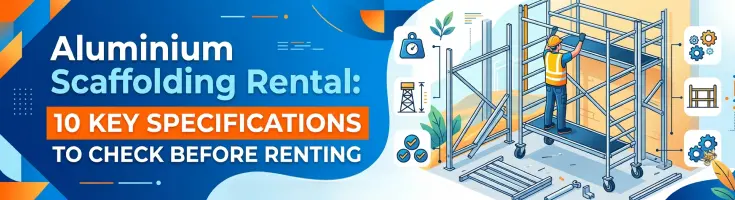
Aluminium scaffolding has become a common sight on interior finishing jobs, painting work, facade repairs, and maintenance projects. It is light, quick to assemble, and easy to move around a site. But being lightweight does not make every unit right for every job, so if you are comparing options for aluminium scaffolding rental in Chennai, the specification sheet deserves as much attention as the price.
A unit that looks fine in the yard can turn out to be wrong once work begins. It may be too low, too weak, too wide for a corridor, or missing a safety part. These problems are easy to avoid if you know what to ask, and most of them only show up after the crew has started, when a fix means stopping the job and paying for a replacement. Here are ten specifications worth checking before you sign.
1. Material Grade and Build Quality
Not all aluminium is the same. Good scaffolding is made from structural-grade aluminium alloy, which gives strength without adding weight, while cheaper units sometimes use thinner tubes or lower-grade material that bends and dents quickly.
Ask the supplier about the alloy and the tube wall thickness, then run your hand along the frames and look closely at the welds. Clean, even welds and straight tubes are a good sign. Cracks near the joints, visible repairs, or uneven surfaces are reasons to walk away. A few minutes of checking now is far cheaper than a failure on site.
2. Load Capacity: How Much Weight the Scaffolding Can Safely Carry
Every platform has a limit, and that limit covers more than the weight of the workers. Tools, paint buckets, drilling machines, and materials all count. Ask for the safe working load, and confirm whether the figure applies to a single platform or to the whole structure.
Be honest about what you will place on it, because a painter with a brush needs far less capacity than a crew fixing heavy panels. If the supplier cannot state the capacity clearly, treat that as a warning sign. It is always better to choose a unit with some margin than one that sits right at its limit.
3. Working Height vs Platform Height: Picking the Right Tower Size
These two numbers are often confused. Platform height is how high you stand, while working height is roughly how high you can reach, usually about two metres more than the platform height.
Measure the area you need to cover and choose accordingly. Many contractors rent a tower that is slightly short and end up stretching dangerously to finish the job. Others rent one that is too tall and pay more than they need to. Getting the height right saves both money and risk. If the work happens at different levels, ask whether the tower can be adjusted instead of renting two separate sizes.
4. Platform Size and Footprint: Will the Tower Fit Your Site?
The platform needs enough room for people to work comfortably, but the base must also fit the space you have. Check the length and width of the platform along with the footprint of the tower on the floor.
This matters most indoors. A tower that will not pass through a door or fit between two walls is no use, however good its specifications look. Take your site measurements with you when you speak to the supplier, and include lift widths, staircase turns, and any narrow passages the tower has to travel through.
5. Scaffolding Weight: Why Lightweight Aluminium Towers Are Easier to Handle
One of the main reasons people choose aluminium over steel is that it is easier to handle. Even so, weight varies between systems, so ask how much the complete tower weighs and how much the heaviest single piece weighs.
Choosing aluminium only makes sense if the tower is genuinely light to work with. Picture your crew lifting each section up several flights, or building the frame on an open roof: lighter pieces cut the effort, speed up the build and lower the risk of injury. A bulky system takes that benefit away. Before assembly, also confirm the slab or floor underneath can handle the tower, the crew and the materials together.
6. Locking and Joint Mechanism
The joints hold the whole structure together, so check them closely. Quality systems use secure locking pins, clamps, or snap-lock connections that click firmly into place, and the parts should fit without force and without too much play.
Loose or worn locks make a tower wobble, and a wobbling tower is an accident waiting to happen. Ask the supplier to show you how the pieces connect, and test a few joints yourself. If any lock feels weak, ask for a replacement. Also confirm that spare pins and clips are included, since these small parts go missing easily on busy sites.
7. Wheels, Brakes and Stabilisers
Most aluminium towers are mobile, which is a big advantage, but only if the wheels are reliable. Inspect each castor. The wheels should rotate smoothly and the brakes should lock firmly, because a brake that slips under load can send the whole platform rolling while someone is standing on it.
Also check whether outriggers or stabilisers come with the tower. They widen the base and keep the structure steady at greater heights, and without them taller towers can become unstable, especially on uneven floors. As a rule, lock every brake before anyone climbs up, and never move the tower with people or materials on the platform.
8. Guardrails, Toe Boards and Access Ladders
Falls are the biggest danger when working at height, so the protective parts matter. Check that the rental includes guardrails on all open sides, toe boards to stop tools from dropping, and a proper ladder or stair for climbing up.
Some suppliers quote a low price by leaving these items out. When you look for aluminium scaffolding for rent, confirm what is included in the set and what costs extra. Never agree to use a platform without guardrails.
9. Platform Surface and Anti-Slip Features
The platform surface is where your crew spends all its time, so it should be flat, firm, and slip-resistant. Plywood or aluminium decks with a textured finish give better grip, especially when the work involves water, paint, or dust.
If there is a trapdoor or hatch, make sure it closes securely. Look for cracks, warping, or damaged edges, because even a small defect can cause a trip or a fall. If the job involves wet processes such as plastering or washing, ask specifically how the surface grips under those conditions.
10. Safety Certification, Inspection, and Maintenance History of Rental Units
Finally, ask about the equipment’s standards and upkeep. Reputable suppliers can tell you which safety standards their systems follow, such as those used for mobile access towers, and how often units are inspected between rentals.
A supplier who keeps a maintenance record and replaces damaged parts quickly is far more trustworthy than one who simply cleans the frames and sends them out. If you can, request an inspection at delivery, and have your own supervisor check the unit again before anyone climbs on it. Ask for a short assembly guide too, so your crew knows the correct way to set the tower up.
Aluminium Scaffolding Rental Checklist
- Measure the work area, the height, and the access route first
- Ask for the specifications in writing, not just over the phone
- Check the floor and ground conditions where the tower will stand
- Keep a written record of the condition at delivery and at return
Choose the Right Aluminium Scaffolding Rental Supplier in Chennai
Choosing the right aluminium scaffolding comes down to details: the material, the load rating, the height, the locks, the wheels, and the safety fittings. Spending a few minutes on each one protects your crew, your schedule, and your budget. A good aluminium scaffolding rental in Chennai should make the job easier, not add new problems to it.
If you want a supplier who answers these questions clearly and delivers equipment in dependable condition, MBF Enterprises is a good place to start. With well-maintained aluminium scaffolding on rent and a team that understands what contractors need on site, MBF Enterprises can help you pick the right setup and begin work with confidence.