
Walk into any building at the MEP stage in Chennai and you will see the same picture. The HVAC crew is hanging ducts. An electrician is pulling cable trays along the ceiling. A plumber is lining up risers. And somewhere in the middle of it all, a ladder tied to a column is doing the job a proper platform should be doing.
This is where most access-related delays and accidents begin. In this guide, we explain how to plan scaffolding for MEP installation so that each trade gets stable, safe access and the schedule does not suffer for it.
Safe MEP access comes down to five decisions: the type of scaffold, the working height, the load capacity, who inspects it, and how it moves as the work moves. Settle these before the first duct goes up and most site problems never show up.
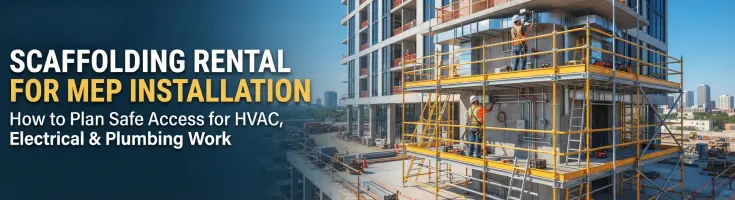
Why Does MEP Work Need a Different Scaffolding Plan?
Structural scaffolding is built once and mostly stays where it is. MEP work does not behave that way. A crew finishes one ceiling run, then shifts ten metres and starts again. The materials are awkward too: a 3-metre duct section, a loaded cable tray, a length of cast iron drainage pipe. All of it is lifted overhead and held in place while someone fixes it.
Then there is the overlap. HVAC, electrical and plumbing teams often share one floor, and a platform built for one trade may be too narrow, too low or too weak for the next. Planning access once, for all three, saves you from tearing down and rebuilding halfway through the project.
What Scaffolding Access Does Each MEP Trade Need?
HVAC installation
Ducts and chilled water pipes sit high, usually just below the slab. Crews need a wide working platform, not a couple of planks, because they are lifting bulky sections and bolting them in place. Mobile towers on lockable castors work well here. Check the platform rating against the real load: the duct, hangers, tools and two or three people standing on it.
Electrical work
Cable trays, conduits and light fittings need steady access along a line, so the platform must be level and easy to reposition. Keep metal scaffolding away from exposed live conductors. Isolate the supply first, or use non-conductive fibreglass towers where that is not possible. Good lighting on the platform matters more than most site teams expect.
Plumbing and fire fighting
Risers, drainage lines and sprinkler pipework mean heavy pipe and plenty of overhead drilling. Shaft work needs scaffolding built inside narrow openings, with full guardrails and toe boards so that tools and fasteners do not fall on people below. Plan for the pipe length itself, because that is what usually causes handling trouble.
Which Type of Scaffolding Is Best for MEP Projects?
There is no single best system. Match it to the job:
Frame scaffolding: quick to set up and good for large, open floors such as basements and warehouses
Cuplock scaffolding: flexible for irregular layouts, shafts and atriums, and widely used on Indian sites
Mobile tower scaffolding: ideal when crews move along a ceiling run every few hours
Aluminium towers: light and easy on finished floors, a good fit for fit-out and interior work
MEP phases are short and the layout changes from floor to floor, which is why many contractors prefer Scaffolding on rent instead of buying. Renting lets you scale up when trades overlap and return what you no longer need. If you only need extra base jacks, guardrails or couplers to complete a system, scaffolding material rental in Chennai can fill that gap without the cost of a full set
MEP Scaffolding Planning Checklist: 7 Questions to Answer First
Before the scaffold is ordered, walk the site with the MEP coordinator and answer these questions:
What is the working height on each floor, and does it change in plant rooms or double-height areas?
Which trades will use the same platform, and at what times?
What is the heaviest load, including materials, tools and people?
Is the floor strong and level enough to take the base plates? Use sole boards on soft or uneven ground
Where will the scaffold need to move, and how often?
How will materials reach the platform: by hand, by hoist or by a separate lift?
Who will inspect the scaffold, and how often?
Write the answers down and share them with the scaffolding team. Verbal instructions on site have a way of changing by the time the crew arrives.
Scaffolding Safety Rules Every MEP Site Should Follow
Indian standards such as IS 4014 and IS 2750 cover steel tubular scaffolding, and your supplier should be able to tell you how their equipment meets them. Beyond that, a few habits make the biggest difference:
Trained erectors only: Putting up a scaffold is skilled work. Qualified scaffolding contractors in Chennai will use trained crews who know how to read the load plan and brace correctly
Full edge protection: Guardrails, mid-rails and toe boards on every working platform, with no gaps
Inspect before every shift: A supervisor should check base plates, ties, braces and decking, and tag the scaffold as safe or unsafe
No overloading: Do not stack ducts or pipes on the platform beyond the rated load
Harnesses where needed: Use them when erecting, dismantling or working near open edges
Stop work after changes: If anyone alters or removes a part, the scaffold is re-inspected before anyone climbs it again
Treat these as site rules, not suggestions. Most accidents on scaffolds come from a missing plank or a removed brace, not from some rare failure.
Scaffolding Challenges on Chennai Sites
Our city adds its own challenges. Humidity and salt-laden air from the coast speed up corrosion on poorly maintained steel, so check pipes and couplers for rust and bent ends. During the northeast monsoon, soft ground around the site can shift a base that looked solid the day before. Summer heat means crews tire faster on elevated platforms, so build in rest and water breaks.
Large projects along OMR, in Guindy and Ambattur, and in the Sriperumbudur industrial belt also depend on timely delivery. Traffic and permit hours can hold up a truck, so order scaffolding a few days before your MEP crew needs it, not the morning they arrive.
How to Choose a Reliable Scaffolding Provider in Chennai
When comparing scaffolding suppliers in Chennai, look past the price per piece. Ask to see their material, because well-kept equipment tells you a lot about how they run the business. Ask whether they provide site support, load guidance and replacement parts when something is damaged. A good scaffolding rental company in Chennai will visit your site, understand the MEP sequence and recommend a system that suits it, rather than send whatever is in stock.
A few other questions worth asking:
Do they supply complete systems and individual components?
Can they deliver and collect on a schedule that matches your phases?
Will they support you if the work area changes mid-project?
Do they share inspection and safety guidance with your site team?
Plan MEP Access Before the First Duct Goes Up
Good MEP work starts with good access. When the scaffold is chosen for the trade, checked against real loads and inspected every day, HVAC, electrical and plumbing crews can finish their work faster and go home safe. If you are planning an upcoming project, speak to a team that understands how MEP sequences work on site. At MBF Enterprises, we provide scaffolding rental services in Chennai for building, industrial and interior projects, with the right equipment and practical guidance to keep your crews working safely at height.